Sapa is a town in Vietnam’s northern frontier, very close to the Chinese border. The local people in Sapa do not speak Vietnamese, at least not as their first language. They are the Hmong people, ethnic minorities, farmers in the vast valleys of the northern peaks. They are all very, very small. The women marry at 16 or 17, prearranged, have multiple children by 20, and live their entire lives in this mountainous community. In Hmong culture, men and women (or boys and girls, really) are not allowed to have physical contact until marriage. No sex, no kissing, no handholding. The men spend their days doing construction and landscaping the village or farming the land. The women cook, farm, and make handicrafts to sell to tourists. The latter of these ventures was particularly evident during my two-day trek.
Evan and I took a night train from Hanoi to Lao Cai, which is about an hour from Sapa. We paid for a 1st class soft sleeper cabin, the finest accommodation available. Upon boarding the train we were dismayed to find ourselves in a very small cabin with even smaller beds. Joining us was a family of three (despite that cabins only have 4 beds in total), including a crying baby and a father with the stomach flu. Evan and I took the top bunks so that the family could be together and the man could have easier access to the bathroom. The most accurate descriptor I can think of for my bunk is a coffin. Lying on my back, my face was maybe 18 inches from the ceiling. Neither of us slept very well.

Sapa valley
The next day we began our trek with 8 other travelers. Evan, Julian, and I were the Americans, Frederick was from Denmark, one guy from Indonesia, but most were French – Julian, Paradis, Thierry, Emanuella, and an older gentleman whose name escapes me. A short Hmong woman names Chu was our guide. The morning’s walk was lovely, scenic, vast vistas and fresh mountain air greeted us with each step.

Evan and me with Chu

me and my “friends” on Day 1
Aside from Chu maybe a dozen more Hmong women joined us on the trek. They were our “friends.” I appreciated their company very much initially, they spoke good English, answered all of our questions about their culture, and even lent us a strong hand when the terrain became steep and muddy. Once we stopped for lunch, however, I discovered that this friendliness had come at a cost. I wanted to give them something anyways for all their help on the trail and for offering so much information, but their charm and innocence disappeared in a flash as they shoved their handicrafts in my face, demanding very high prices. “That’s too much,” I’d say, and they’d reply “But I help you.” Apparently help isn’t free.
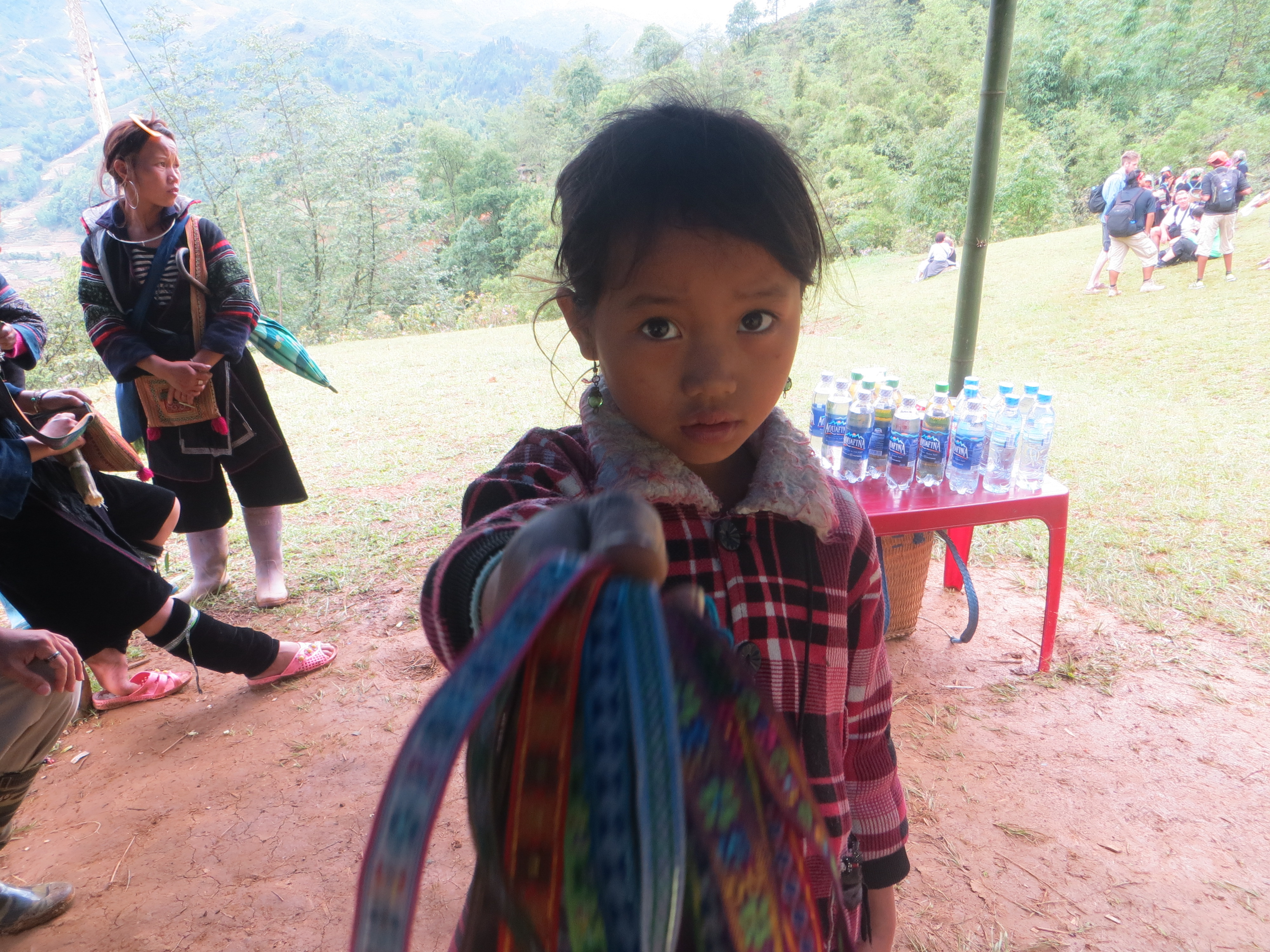
this girl held bracelets in my face, whimpering “Buy from me!” over and over for more than 10 minutes (not an exaggeration)
Lunch was spent with dozens of little hands in my face trying to sell bracelets. The words “no thank you” fell on deaf ears. They were relentless, standing over me, pleading, whimpering with puppy dog faces, giving up only after they were ignored at length, then moving on to their next prey. Enduring this during our lunch break after a long sweaty trek was, needless to say, a very unpleasant experience. I mean, I can only reject so many cute, impoverished children before I begin to feel bad about myself.
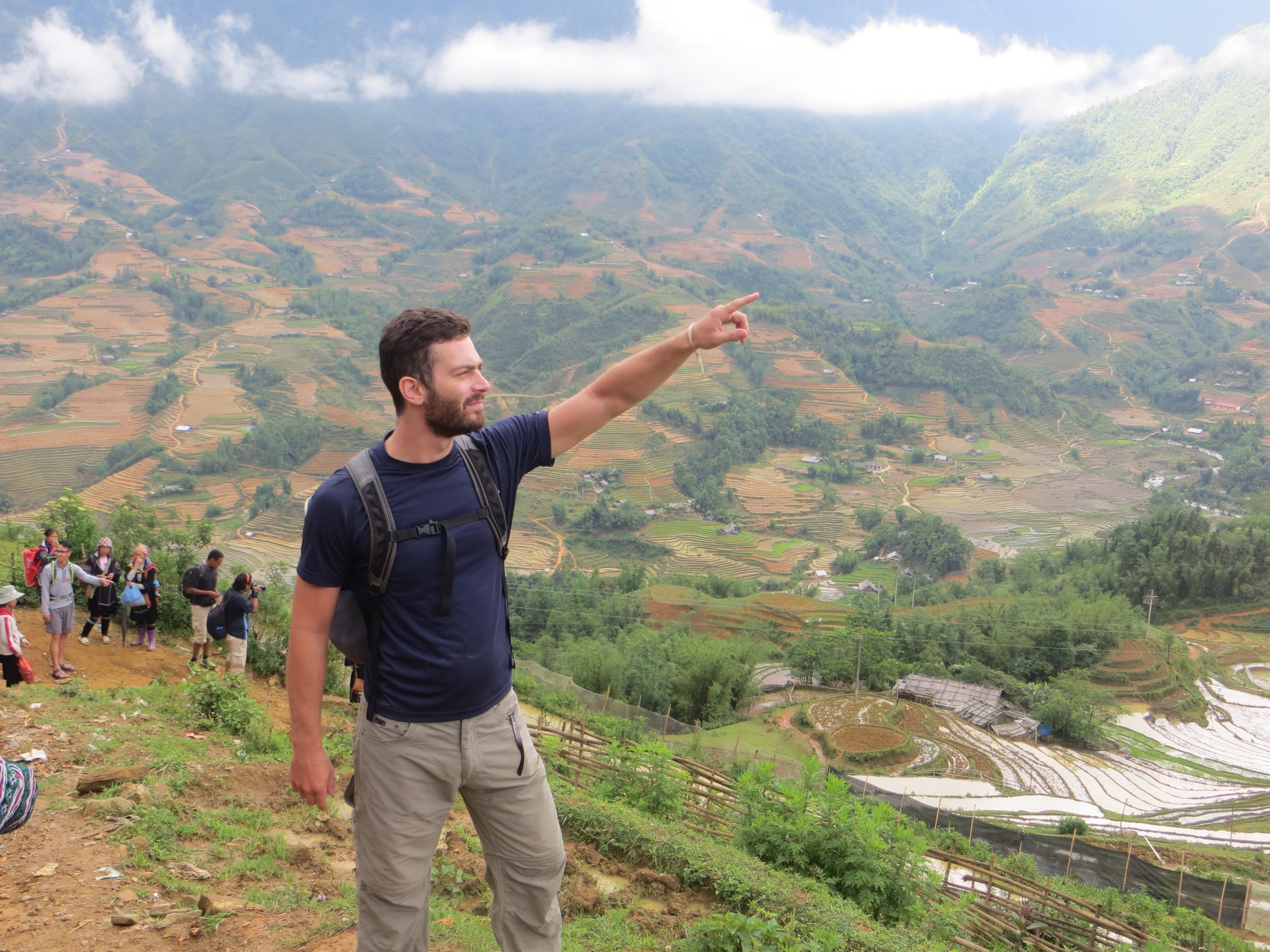
look over there!
As we continued trekking after lunch, an older Hmong woman approached me and asked if she could be my “afternoon friend,” to which I replied: “Do you really want to be my friend, or do you just want me to buy your handicrafts? Be honest.” She said, “I give you good price.” Heard that before.
We visited a school in a village nearby where the children were doing their afternoon exercises in the courtyard. I had my suspicions, however, that this was planned as a ploy to generate donations. Regardless, here’s some brief footage of the kids doing their exercises.
As we walked for another hour to our homestay I couldn’t help but feel a bit let down. Here I was, trekking in the mountains with ethnic minorities, and I was being shaken down for my whiteman’s purse at every turn. I suppose it should be expected given the popularity of Sapa tours.
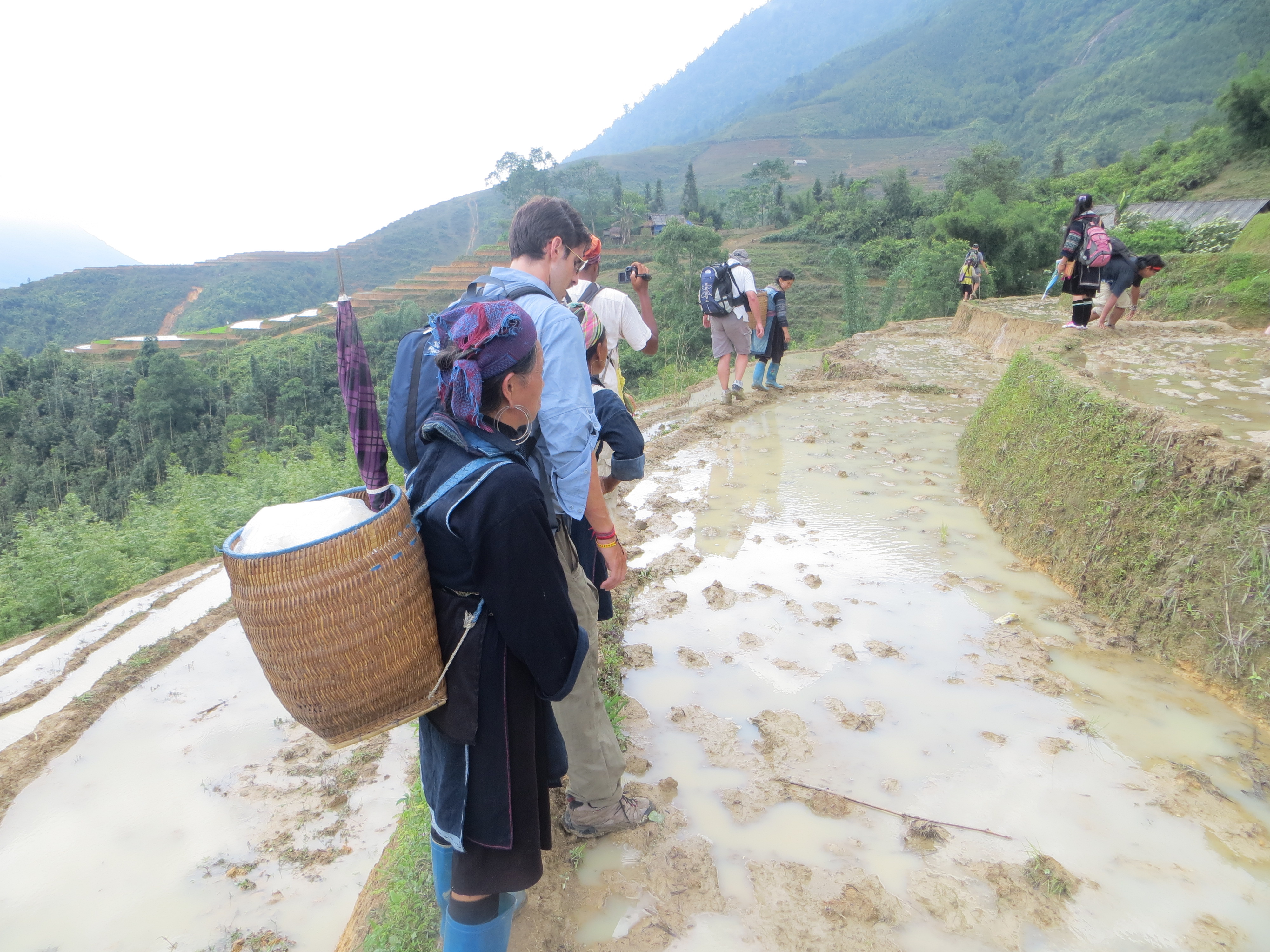
teetering on the terrace rim
I took a nap when we arrived at our homestay. Dinner that night, local rice wine, and a long game of Jenga followed in the evening. After breakfast the next morning we trekked for about 4 hours until lunch. This leg of the trek was strenuous, hot, steep. We tiptoed along the rim of the rice terraces for a long while, some weren’t lucky and slipped in.
I was on shaky ground for much of the trek on Day 2 so I couldn’t help it when an older Hmong women took my hand to keep me steady at certain intervals. I knew even an occasional helping hand would cost me, and I was right. She was very aggressive when we stopped for lunch, even hitting me rather hard when I momentarily considered another woman’s goods. I did want to give her something, though, but she knew this and ran up the price very high. “I help you,” she said. Lunch was no different from the day before, tons of women refusing to give me a moment’s peace or take no for an answer.
Though I was discouraged at times by the traps set for me and fellow trekkers, I’m grateful that I went to Sapa. The views were wonderful, the trekking strenuous yet fun, and though it cost me something, I learned much from these people.

everyone on day 2 of the trek (back row from left to right: Paradis, Frederick, Evan, Indonesian and then Frenchman whose names I forget, ME!, Julian, Thierry, Emanuella)


 milesawayfromhome
Posted on May 22, 2013
0